
Livewire Exclusive Article – Where are we in this bull market?
Sir John Templeton famously said; “bull markets are born on pessimism, grow on skepticism, peak on optimism and die on euphoria.” With the S&P 500 hitting new highs, and growth returning around the world, it’s natural to question how far along the path we are today.
It’s a confusing backdrop for investors. Unemployment is nearing ‘full employment’, inflation remains low, and a growing chorus of fund managers are bullish on markets and economies. However, the spectre of political uncertainty and secular stagnation are still fresh in most investors’ minds.
To get some clarity on these issues, we reached out to three leading economists to get their opinion on the current stage of the cycle. Responses are by Tim Toohey from Ellerston Capital, Nick Bishop from Aberdeen Standard Investments, and Sam Ferraro from Evidente. https://www.livewiremarkets.com/wires/where-are-we-in-this-bull-market
A quantum leap in logic
Tim Toohey, Economist, Ellerston Capital
We believe there is a significant difference between the credit cycle and the business cycle. The evidence suggests that in most developed markets we are relatively late in the credit cycle yet in terms of the business cycle most countries are printing data consistent with being before the mid-point of the business cycle. The key exception being the US which has recently moved beyond the mid-point of the cycle.
It is important to remember that in the middle of 2016 financial markets and policy makers remained convinced that they were still stuck in either a debt deflation cycle, which was yet to end, or, worse still, had entered a period of secular stagnation that may never end. We believed that an upswing in a traditional global industrial cycle had commenced in 2Q16 based on several indicators;
- Excess credit indicators suggest the industrial sector would turn.
- Traditional early bell weather indicators such as semi-conductor sales and forward order surveys indicated that global demand had shifted course and;
- After several false starts for business confidence post crisis, finally global consumer confidence had started an ascent.
In short, a broad collection of data suggested that the secular stagnation thesis was wrong, and a global industrial cycle had commenced.
Trump’s election win, and his unfunded promises, provided the excuse for financial markets to embrace the economic reality. However, by early 2017 something very peculiar happened. Market participants who only months earlier had been convinced of secular stagnation then leapt to the conclusion if we are no longer in stagnation we must be late in an industrial economic cycle.
The argument ran that the US economy was in the 8th innings of a 9 innings stretch. This quantum leap in logic defied everything we know about the sequencing of events that occurs, with relatively predictable rhythm, through an industrial cycle.
The exhibit that we would nominate to understand where we are in the business cycle is not a single indicator, but rather a schematic of the various steps of a traditional industrial cycle, as shown below, and then pose the question where do the major countries now sit on this cycle?
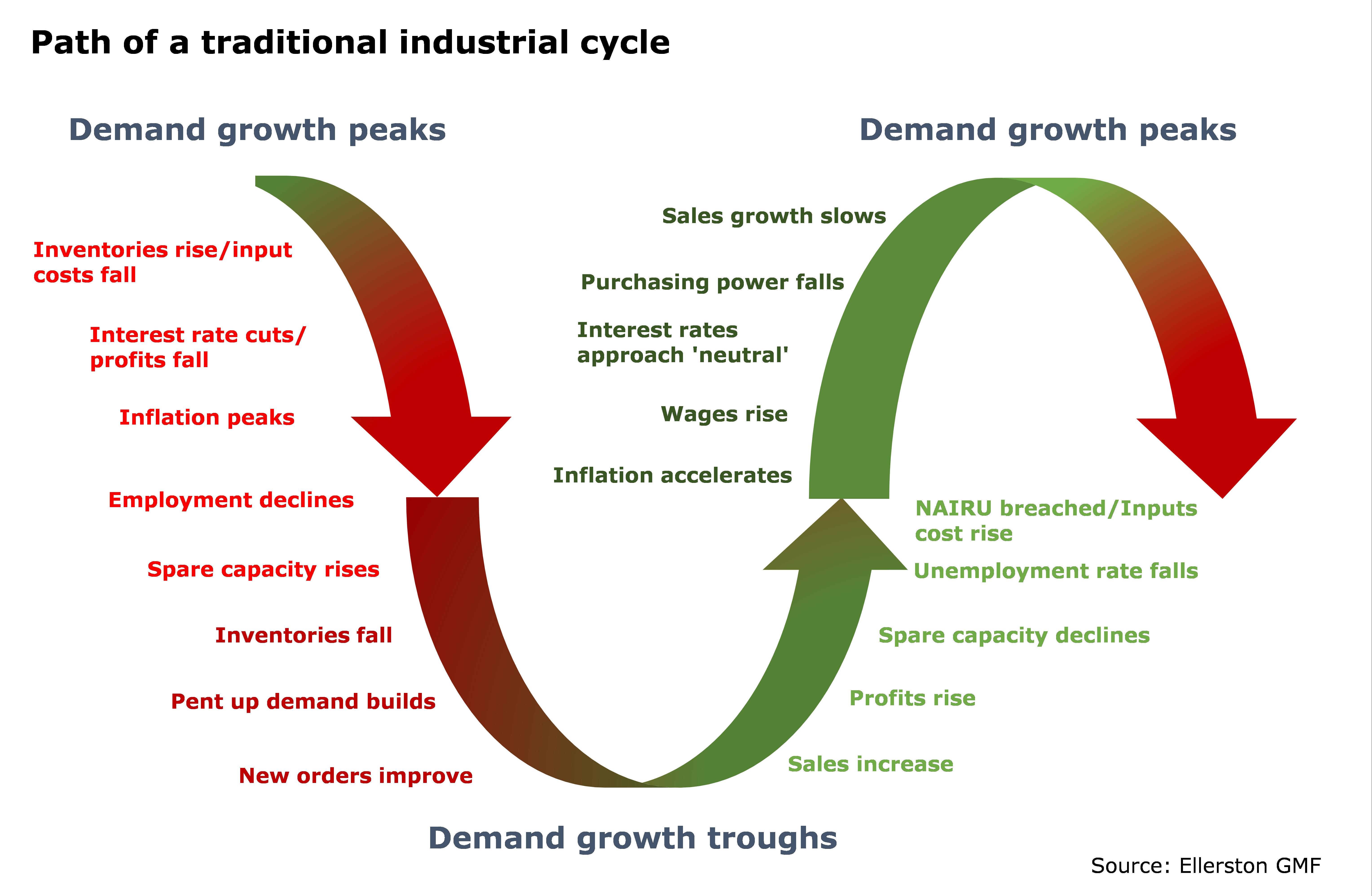
By mid-2016 any reasonable assessment would have placed the US economy in the phase of the cycle that depicted diminishing spare capacity and falling unemployment. Currently, the Fed is still debating whether they have breached NAIRU, although most of the FOMC believe they currently have an unemployment rate that is now below the level consistent with stable inflation. In sequencing of the steps of the cycle all the other major developed and indeed the developing economies reside firmly behind the US.
In the absence of a very sharp rise in inflationary pressure, this is an economic cycle that could easily extend for a further couple of years before it reaches its peak.